

 Friday 21 August 2026
 Ferhunde
CPU or GPU? Which Hardware Component Is More Important for Gaming? When building a gaming PC or upgrading an existing system, one of the biggest ques...
See more
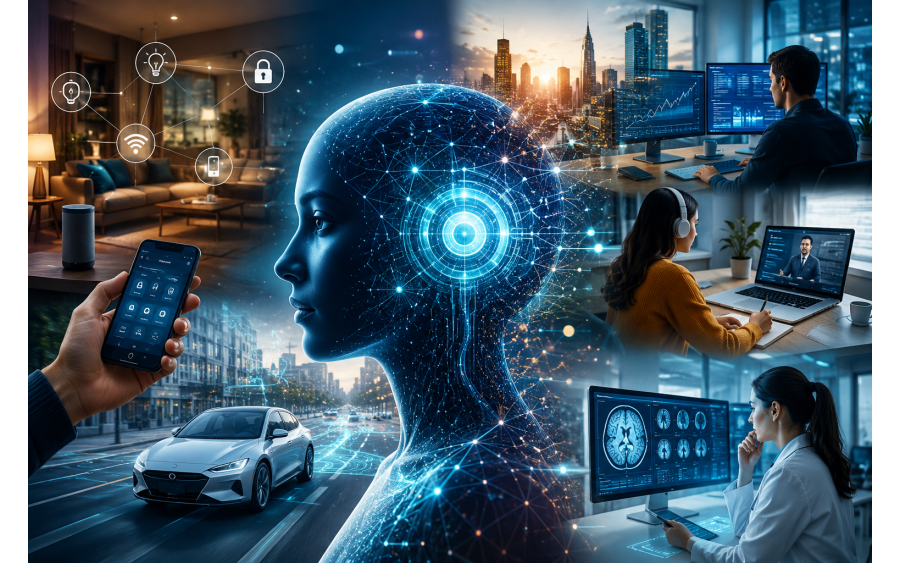
Artificial intelligence (AI) has become an important part of everyday life in recent years, not only in the world of technology but also in our daily routines. AI technologies are used in many areas, from smartphones and online shopping platforms to social media and educational applications. In fact, we often benefit from these technologies without even realizing that artificial intelligence is involved.
So, how is artificial intelligence changing our daily lives? How does it affect our habits, the way we work, and the way we access information? In this article, we will explore the areas where artificial intelligence is used in everyday life and the changes it may bring in the future.
Artificial intelligence is a general term for technologies that enable computers and digital systems to perform tasks similar to humans, such as learning, analyzing information, solving problems, and making decisions.
Thanks to technologies such as machine learning, natural language processing, and image recognition, AI systems can analyze large amounts of data and perform specific tasks.
Today, artificial intelligence is no longer a technology used only on advanced computers. AI applications are now integrated into many devices we use in our daily lives, from smartphones to automobiles.
The areas where artificial intelligence is used are expanding every day. Some of the most common examples we encounter in daily life include:
Smartphones are one of the most common examples of artificial intelligence in everyday life.
Voice assistants, automatic image enhancement features in camera applications, facial recognition systems, and predictive keyboards can all benefit from AI technologies.
For example, if your smartphone predicts the word you are about to type or automatically adjusts the lighting in a photo you take, AI-powered technologies may be working in the background.
Millions of people use search engines every day to find information online. Artificial intelligence plays an important role in matching search results with what users are looking for.
With the help of AI, the intent behind a user's search can be analyzed more effectively, allowing search engines to provide more relevant results.
This makes accessing information easier while also increasing the importance of artificial intelligence in the digital world.
The content we see on social media platforms does not appear completely at random.
AI-powered algorithms can analyze the videos users watch, the posts they like, and the content they interact with to create personalized content recommendations.
As a result, two people using the same social media platform may see completely different content.
Artificial intelligence technologies are also widely used on e-commerce platforms.
Recommending similar products based on products you have previously viewed, your purchases, or your interests is an example of an AI-powered system.
Artificial intelligence can also be used in customer service chatbots, product search systems, and personalized shopping experiences.
One of the most important areas affected by artificial intelligence is the workplace.
Many repetitive and time-consuming tasks can be completed more quickly with the help of AI-powered tools. Artificial intelligence can assist employees with tasks such as content creation, data analysis, translation, preparing meeting notes, and customer service.
This can help employees spend more time on creative and strategic tasks.
However, it is also important to recognize that artificial intelligence may change certain professions and business processes. In the future, the ability to work effectively alongside AI may become increasingly important across many professions.
Artificial intelligence is also creating significant changes in education.
Students can use AI-powered applications for explanations, solving questions, practicing foreign languages, and conducting research. Teachers can also use artificial intelligence to prepare educational materials, create questions, and analyze students' learning processes.
However, it is extremely important to verify the accuracy of information when using AI in education. Not every piece of information generated by artificial intelligence is necessarily correct.
Artificial intelligence can be used in many areas of healthcare, from detecting diseases to analyzing medical images.
From the perspective of everyday life, smartwatches and various health applications make it possible to track information such as sleep, physical activity, and exercise.
These technologies can help people monitor their lifestyle habits more closely.
Traffic predictions and route recommendations provided by navigation applications are also examples of artificial intelligence in everyday life.
These systems can evaluate historical traffic data and real-time information to recommend more suitable routes.
In the automotive industry, driver assistance systems, environmental perception, and autonomous driving technologies demonstrate that artificial intelligence could play an even greater role in transportation in the future.
Some of the most important advantages of artificial intelligence in our daily lives include:
Saving time
Automating repetitive tasks
Analyzing large amounts of data quickly
Providing personalized recommendations
Making information easier to access
Increasing efficiency in business processes
Supporting people in education and work
Because of these advantages, AI technologies may become an even more important part of everyday life in the coming years.
As with any technology, artificial intelligence also comes with certain risks.
The protection of personal data, the generation of inaccurate or misleading information, copyright issues, and the impact of AI on employment are among the major topics of discussion.
It is also important not to assume that content generated by artificial intelligence is always accurate. When making important decisions, information should be verified using multiple reliable sources.
Artificial intelligence is expected to become even more visible in everyday life in the future. AI-powered technologies may become increasingly common in areas ranging from smart home systems and personal assistants to education and automotive technologies.
In the future, artificial intelligence may go beyond being a tool that performs specific tasks and become a more active assistant in people's daily planning, work, and information-gathering processes.
The most important point will be to view artificial intelligence not as a technology that completely replaces humans, but as a tool that supports and enhances human abilities.

CPU or GPU? Which Hardware Component Is More Important for Gaming? When building a gaming PC or upgrading an existing system, one of the biggest ques...
See more

What Is 5G? What Is the Difference Between 4G and 5G? Everything You Need to Know About 5G Technology Mobile internet technologies are becoming faste...
See more